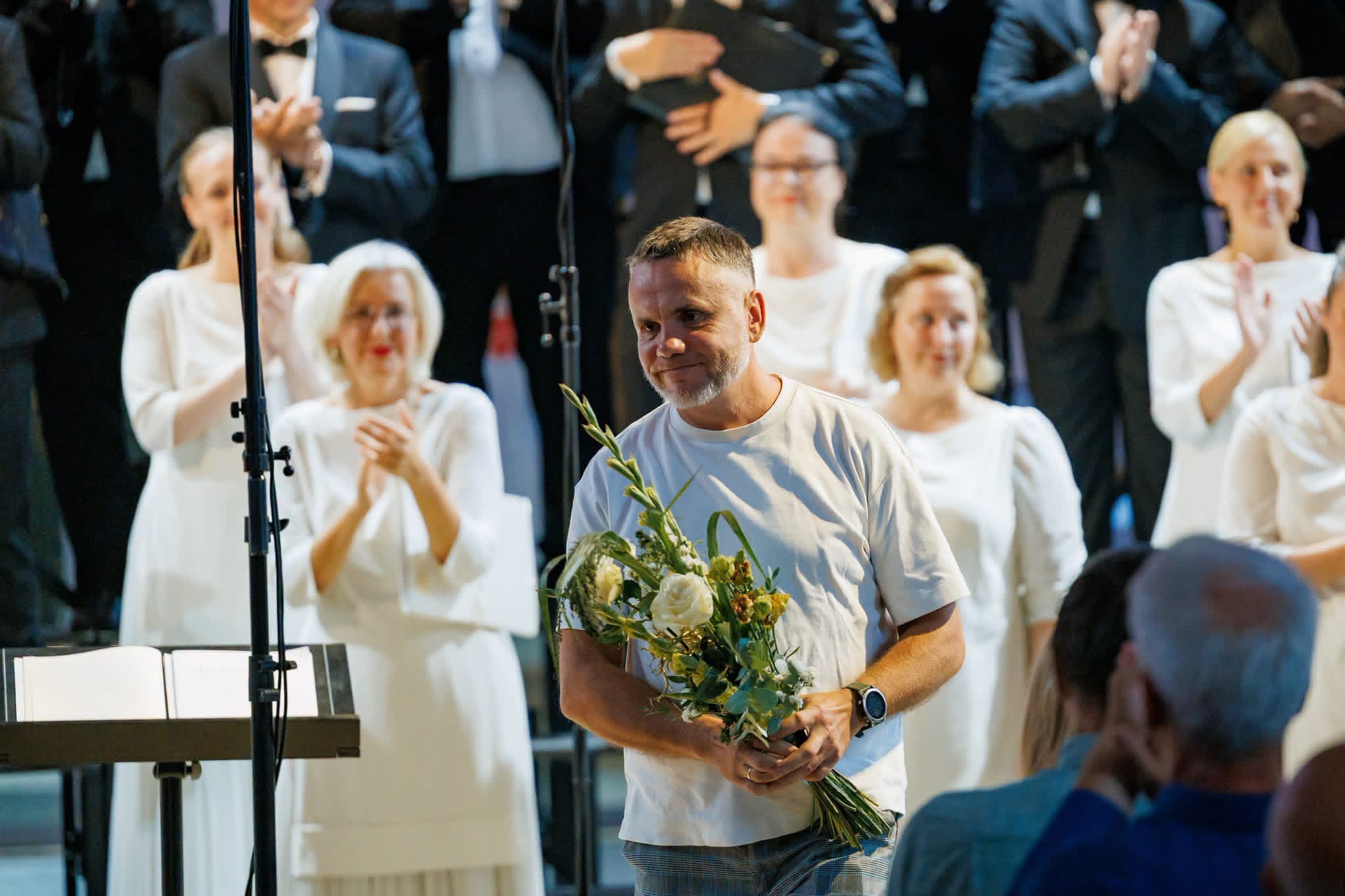
It is such a special feeling to create a connection with my great-aunt’s poetry through music, to meet her in this way, to converse with her life, and to share that conversation with the audience through the wonderful performance by the Latvian State Academic Choir “Latvija” and conductor Marika Austruma.
The premiere of my Zelma’s Songs was outstanding! Musicologist Inese Lūsiņa writes in her review in the newspaper Diena:
“In Marika Austruma’s confident hands, the warm, radiant and deeply felt jewel of the entire evening shone brightly — Andris Dzenītis’s cycle Zelma’s Songs, set to texts by the composer’s great-aunt, Zelma Dzenīte. This five-part cycle for mixed choir a cappella, which also incorporates a soprano solo by Sanita Sinkēviča, is both professionally polished and genuinely heartfelt. Zelma’s Songs is a masterpiece that speaks to us through its mastery of choral texture, rich harmonic language, subtle polyphony and exceptional sense of form, as well as through a refined musical taste rooted in the traditions of Latvian choral music. But above all — it has soul! That special quality that can only come from truthfulness, something that cannot be calculated. The poetic atmosphere that unites the cycle leads us from aleatoric passages rooted in the scales and sounds of folk song, which in the first movement, To Live, alternate with broad, luminous major chords (‘to live is to love’), to the dramatic climax of the fourth movement, Who Is to Blame, and finally, in the song Love, affirms how much can still be expressed through the simplicity of a melodic unison of women’s voices and classical choral texture.”
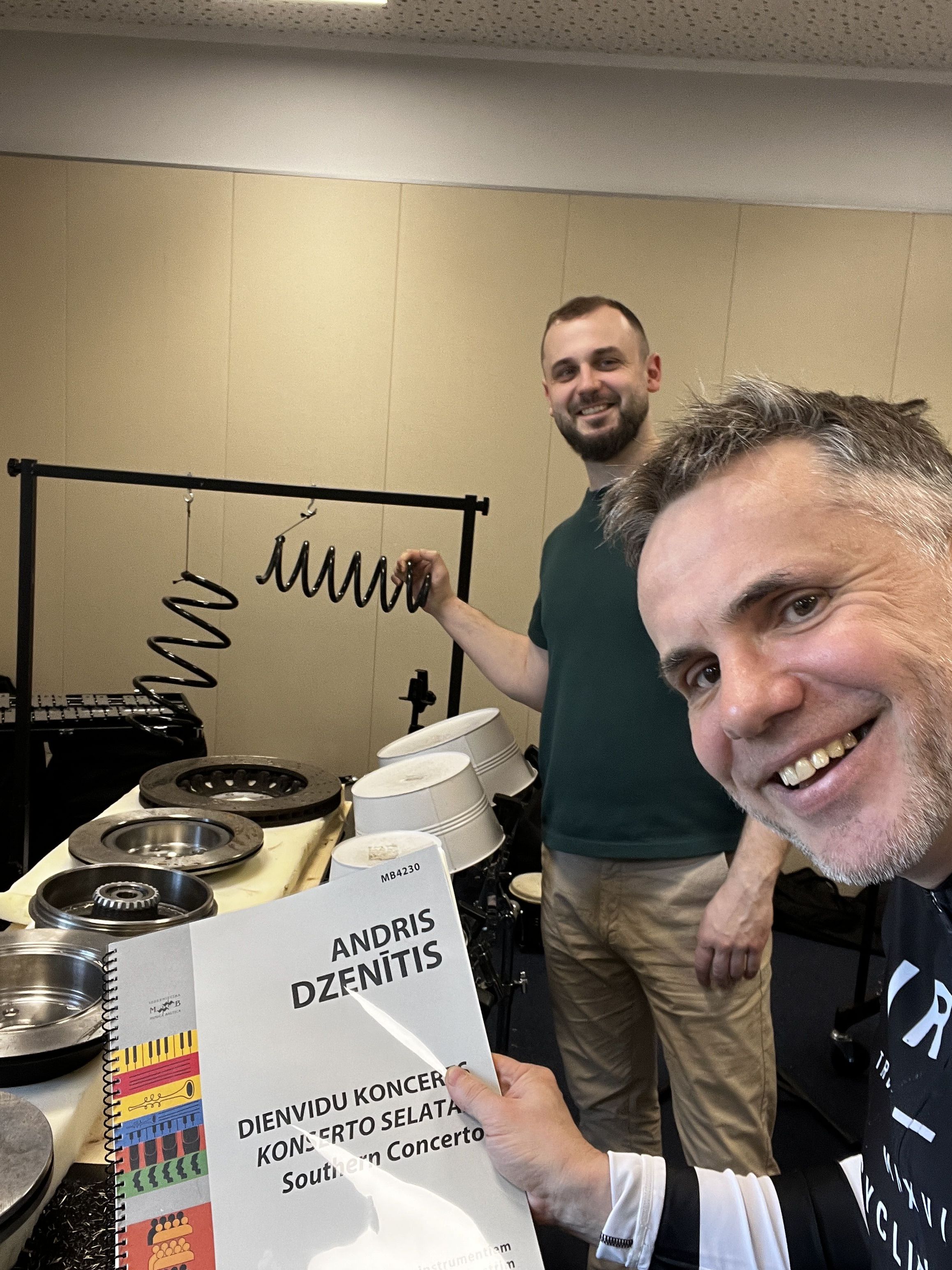
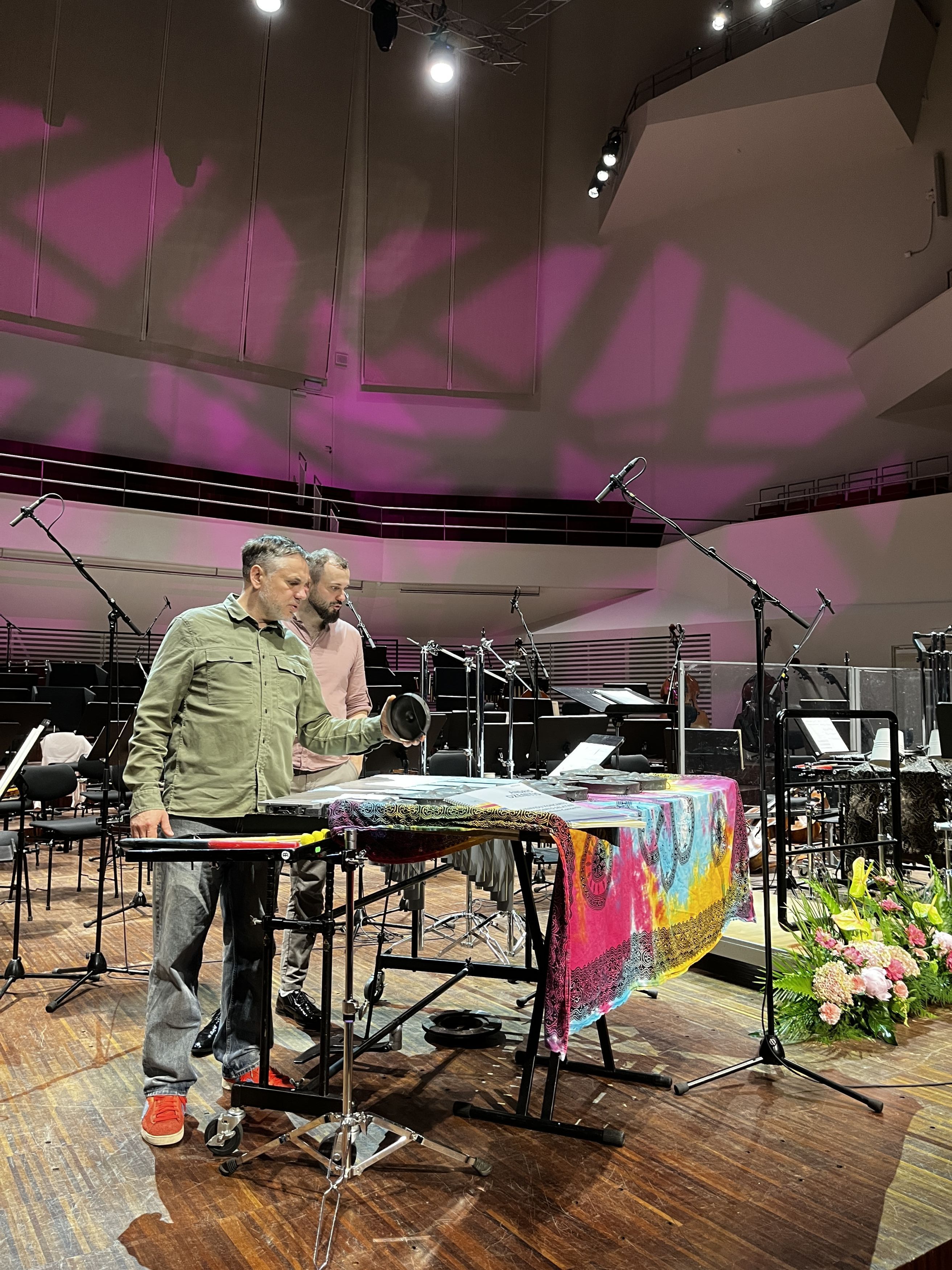
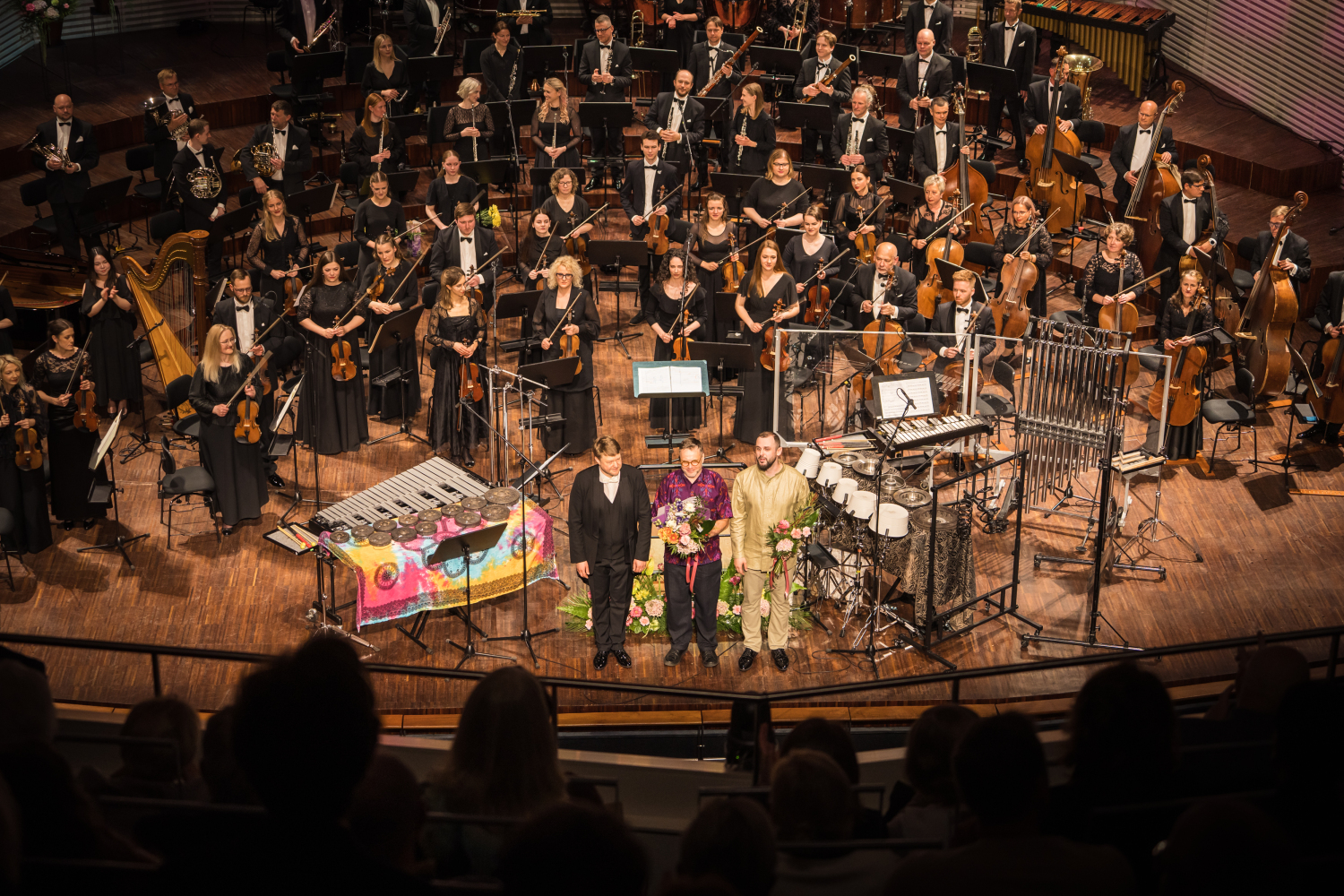
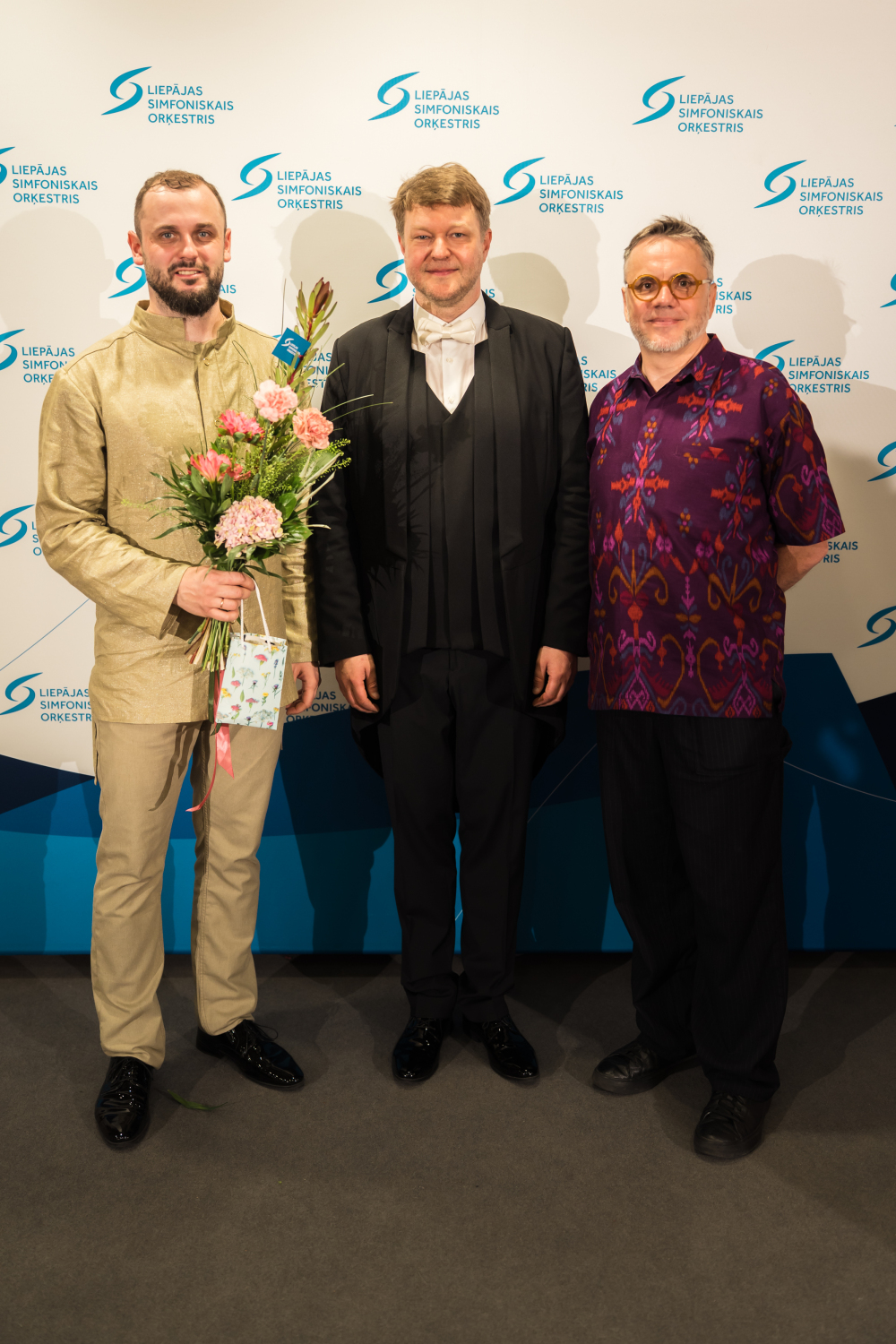
A phenomenal premiere of my "Southern Concerto" ("Konserto Selatan"), inspired by the impressions of Bali and gamelan traditions, on May 16. I am immensely grateful to the fantastic percussionist Guntars Freibergs, the Liepāja Symphony Orchestra, and conductor Guntis Kuzma. Unusual sounds and the joy of hearing the MY orchestra — the orchestration as phenomena is the most exhilarating journey of my composing career. More information about music - back to my notebook page from September 2025.

Yes, yes, I’ve become a writer too — in March my first book of essays was published, Es esmu. Manis nav (or "I exist. I do not")… It’s a surreal feeling to hold your own book in your hands. I’m used to seeing my name on music editions, but having a book is different. The composer Pēteris Vasks, who is celebrating a milestone this year, came to the book launch. By the way, there’s a fairly extensive essay about him in my book, which I dared to read aloud in his presence. I overcome my shyness.


From time to time I realize that it feels completely different to write music at the piano — to feel it in your fingers, to search for and find spontaneous harmonies, to write and erase, write and erase. Throughout the beginning of this year I have been working on a new cycle of choral pieces, "Zelma’s Songs," set to texts by Zelma Dzenīte, my grandfather’s sister — a notable Baptist poet. I met her only once in my life, and this cycle, dedicated to the State Academic Choir "Latvia" and conductor Māris Sirmais, is like a link across time, honoring her memory.

Yes, yes, yes! I'm so proud that this is out now!
If you still like to hold music in your hands, the CD, born on 21.11, is available in all Latvian record stores and international record distributors, such as Amazon, JPS, Presto music, etc. - the discs are accompanied by impressive informative material created by Dāvis Eņģelis, as well as nature images photographed by myself that inspired the composition. But if not - the music is available on well-known streaming sites. Many thanks to Liepāja symphony orchestra, conductors Guntis Kuzma and Christian Lindberg for fantastic performances as well as Egils Šēfers from national Recording label SKANI, orchestra manager Uldis Lipskis for managing. I’d like also to say thanks to Andris Poga and Latvian National symphony orchestra for inspiring creation of Symphony No.2!


There are always these special moments when meeting these special friends in music. This time Guntis Kuzma as clarinetist and pianist Agnese Egliņa in the premiere of my clarinet sonata Mirroring. Wonderful and joyful!


Yesterday I finished my Opus Magnum of this year - a concerto for percussion instruments and orchestra, which I have been working on for almost a year. In terms of the work process, this was definitely one of the most complex and challenging works I have written so far. I hope that it will also be one of the most musically impressive. Almost half an hour of dynamic, equatorial sun-drenched music for western gamelanist Guntars Freibergs. The premiere will be heard at the Liepāja Symphony Orchestra's season finale concert on May 16, with Guntis Kuzma at the conductor's desk.

In February 2024, I finally realized a long-held dream: visiting Bali, Indonesia. From my early teens, when I first
encountered recordings of the Balinese musical drama “Kecak” and the Gamelan music that accompanies shadow
theatre, I was captivated by the island’s rich sonic and ritual traditions. A fortunate convergence of circumstances
allowed my family and me to embark on this journey, turning dream into reality.
Over recent decades, Bali has grown both densely populated and commercialized, transformed by seekers of
enlightenment and digital nomads from the West. Traditions that were once intimate and hidden have often become
commodified. Yet through new friendships, I was granted glimpses into communities and ceremonies typically
inaccessible to tourists: standing near a sacred Gamelan ensemble, whose mallets are touched only once a year
during special rituals; witnessing the dance of maidens celebrating beauty and divinely ordained relationships;
experiencing “Kecak” performances; wandering across lava fields to climb a volcano; and immersing myself in the
fragrant greenery of the island.
The people of Bali inspire with their warmth, generosity, and openness. While there, I received a message from
Guntars Freibergs, inviting me to compose a concerto for percussion—an invitation all the more fitting in the heart of
the gamelan tradition. The Gamelan’s instruments, mostly bronze and metal, inspired me to feature only metal
percussion in the solo part, presenting the challenge of recreating the characteristic gamelan sounds using
instruments available in the West. Hence the concerto’s title. Bali’s music tradition is remarkable in its handling of
complex rhythms and subtle tempo shifts, sensed with an almost instinctive sensitivity. When I asked a gamelan
player how they manage such sudden, synchronized tempo changes, he did not grasp the essence of my question:
these flexible flows of time are guided by the heart.
Each movement of the concerto is dedicated to a significant Balinese tradition or artifact, not merely to illustrate it, but
to reflect upon it through my lens as a Western composer—interpreting, responding to, and celebrating the
extraordinary musical and cultural world of Bali.
I Gangsa
A richly decorated metallophone from the Gamelan ensemble, usually played by the group’s leader. He is at once
conductor and keeper of the melody, the tempo, and its changes. I began writing this movement one evening when I
heard the distant sound of a Gamelan from the street—sounds that, in the end, turned out to be a hallucination of my
own hearing. The soloist’s rhythmic pulse was my imagined deception, which I immediately rushed to write down.
The soloist embarks on a long journey, inviting the orchestral procession to follow.
II Abuang Peteng
The dance „Abuang“ is one of the ceremonial dances performed during religious rituals in the village of Tenganan
Pegringsingan. Slow, harmonious, and lasting several hours, the dance symbolizes devotion to the gods through
beauty, love, and its celebration, expressing hope for harmonious relationships in the future. The dance is performed
by maidens of various ages, dressed in beautiful traditional fabrics. The performance is accompanied by the sacred
gamelan ensemble, „Selonding“.
III Ogoh Ogoh
“Ogoh Ogoh” – Large statues made from wood, paper, straw, and other highly flammable materials, vividly and
frighteningly depicting various demons and negative figures that threaten the harmony of the universe. They are an
essential part of the „Nyepi“ celebrations, marking the Balinese New Year (usually in March). The New Year is
celebrated with grand, colorful „Ogoh Ogoh“ parades through the narrow streets of Bali. At the end of the parades,
the statues are burned, symbolizing the community’s purification from all evil and a fresh start for the year ahead.
This ritual also represents the triumph of the spiritual over the material: crafting these statues is a time-intensive
process, and they possess remarkable artistic value. In Balinese thought, kindness embodies virtue, while wrongful
actions are manifested as demons.
IV Kecak
Also known as the “Monkey Chant” or “Fire Dance,” “Kecak” is one of the most iconic symbols of Balinese culture.
This vocal performance depicts the gods’ struggle against demons, based on the Hindu epic “Ramayana”.
Interestingly, the tradition is not ancient: it was created in the 1930s by the German artist Walter Spies in
collaboration with the Balinese dancer Wayan Limbak. Yet its foundation draws on the traditional sacred Balinese
dance “Sanghyang”, during which dancers enter a deep trance. “Kecak” is a mesmerizing ritual in which dozens—or
even hundreds—of men arranged in a circle perform astonishingly synchronized, complex rhythmic and vocal
patterns. Their movements and vocalizations accompany both the dancers and the storytellers. The soloist concludes
the orchestral “Kecak” with a virtuosic cadenza—a brilliant eruption on the equatorial horizon, just before the Balinese
sunset disappears with remarkable speed.


July is a month in which many whole-hearted and interesting things happen. First of all, my work “Peace with Living Eyes” is for the first time performed at the national song festival, which is so significant for Latvian culture (this year is the 13th time the school song and dance festival is taking place)…


The month in which the premiere of my piece "The Swan" took place ar the Stāmeriena palace, near to my summerhouse, with the wonderful soprano Aija Veismane and cello virtuoso Ēriks Kiršfelds

A month in which I continued to work and completed a draft of my percussion concerto, influenced by the magnificent culture and traditions of the island of Bali.
A month in which I wrote a small piece for the choir “Mīlestībai” ("To the Love"), with the lyrics by my great-aunt Zelma Dzenīte. I am composing her spiritual poetry for the first time.


A month in which I am happy to work with young composers at the Young Musicians Masterclasses in Sigulda - an event that once, more than thirty years ago, significantly changed also my life as a young musician.

"Silver is the color of winter
Silver is the color of the moon and flowing water
Silver is the color of pipes and strings
It reflects, protects, gives patience
Joy, life and movement in silver"
Better late than never. Finally, I experienced the long-awaited premiere of the piece "Sudrabs" (Silver), which was written for an unusual setup - organ and piano, and was commissioned by the Elbphilharmonie Hamburg. I know well "the organ Queen" Iveta Apkalna since my teenage, but it was a pleasure to meet pianist Herbert Schuch first time (and hope - not the last one). These are special emotions standing on the state of the Elbphilharmonie - both during the rehearsals at one o'clock in the morning, and of course - at the concert itself. The response from the audience was warm! Thank you!


March 14th was the birthday of my 3rd symphony "Arcadia". This time with my friends, the orchestra "Sinfonietta Rīga". I am also very happy about the result, about the ovation, about the fact that I have taken a new step into the unknown for myself. This is a different symphony. "Arcadia" is the world in which we, creative people, can build a world in which we ourselves feel relaxed and comfortable, in which the colors, the images we want prevail, in which there is a sort of refuge. I wanted to build a world that is a refuge for myself and, perhaps, for some of you as well. A world behind which, somewhere in the distance, there is a barely perceptible cosmic objectivity... I invite you to listen to the recording of the premiere!


Omega and Alfa. Inspiration is often unexpected. Then works arise that no one has commissioned officially, for which there is no deadline set. 2024 ended with a small piece for soprano and cello The Swan with a fabulously beautiful poem by F.S. Flint...


But 2025 started in deep prayer for a sad event with a new choral work Eripe me, Domine... Rescue me, Lord...

Yeah, yeah, yeah, I know that it is still far from the blockbuster, but every listener among those couple of thousand makes me happy. Recently award winning youth choir "Kamēr..." under guidance of its young, adventurous conductor Patriks Kārlis Stepe, have performed divinely and just published my choral miniature "Peace with living eyes" composed this year with the poetry of the Latvian poet Knuts Skujenieks. Join the audience!

Isn't it wonderful to meet the idol of your teenage years, Christian Lindberg, conducting the premiere of your piece? "The Lonely pine tree. Falsification and epitaph" was born in sounds. Liepāja, "The Great Amber" concert hall, September 14.

Orchestra "Sinfonietta Riga" has always been one of my closest friends in music. This season we will also meet at the premiere of my 3rd symphony "Arcadia" on March 14, 2025. However, the new concert season of the orchestra is starting with the premiere of my composition "Elysium" for strings - this year I created a version for string orchestra from the slow movement of my beloved 4th string quartet. This opus has one of the shortest program notes I've ever written: "A calm presence. When it's most needed." Thanks to conductor Normunds Šnē.


By the way - August and September are the months of new recordings. The national record company SKANI is releasing two CDs, which also contain some of my works written at different periods of life. "Latvian Radio Choir", led by conductors Kaspars Putniņš and Sigvards Kļava, recorded two of my compositions on CD "Angele Dei" - "Om, Lux Aeterna" (2012) and "Prayer" (2023). This disc is already available on all global music streaming sites and physically in stores in 80 countries around the world.

But on September 20, the CD "Sharp green" will be released, in which, among other compositions, there is also my saxophone quartet written under that same name. The main heroes of this disc are saxophone quartet "Atomos". After September 20, look for it both in physical form and online.

To my delight, I discovered that next spring, my music will be played in Hamburg Elbphilharmonie twice with just ten days between the concerts. You are very much welcome!

I am very happy to share my knowledge and experience with young composers in a very special master courses in Madona (Latvia). As well as meeting my dear friends and colleagues Mārtiņš Viļums and Liis Jürgens again.

Teacher and student after the premiere. It's hard to believe that the Latvian Radio Choir has been one of my best friends in music for 25 years, when Sigvards Kļava conducted my Ave Maria for the first time back in 1998. I had just finished studying with Pēteris Vasks, and was a bit pricky. Today - the sudden and unexpected premiere of my opus Prayer, conducted again by Sigvards, turned out to be one of the most emotional moments in my collaboration with this superchoir. There are also far fewer notes than 25 years ago. Sincere thanks!

On December 19, at St. John's Church in Riga - my last premiere of this rich year. There are works that are created for someone, with a purpose, and there are works that smolder silently only for themselves. All this year I have slowly, patiently returned to the Prayer. With great responsibility, only in those moments when it seems that I can and may write down a note. No hurry. While waiting for the first Advent, I thought the piece is ready and it could start it's own life. In gratitude for the life that was given to me to be what it is. This choral composition has versions in Latvian and Latin and is intended for choirs of any technical level. The first, to my great surprise, was the professional choir and the Latvian Radio Choir. I will be happy for your versions in both Latvian and Latin! At the moment, my little video improvisation with a edited non-professional recording of the piece at the day of premiere.

On December 14, stepping into Christmas time, my composition Sharp Green for saxophone quartet, paradoxically written in summer greenery, had its premiere. It was written and dedicated to the saxophone quartet Atomos. Although it is snowing in Riga, the quartet's alto saxophonist Aigars Raumanis cleverly noticed the similarity of Sharp green to the green and sharp Christmas tree. This time - let it be so! The following day, the piece was recorded for a quartet's CD.

About the piece: Sharp green - observation of natural processes full of joy and surprises - when favorable conditions arise, a lively green color bursts out of the ground, the shoot is quickly followed by a continuation - leaves, branches, sections, flowers, fruits, forming ever denser, richer life, more and more amazing formations. Under beneficial conditions, this kind of greening, splitting, growing, leafing, blooming, is also possible in our spiritual and physical lives. Musical material of composition is created as its continuous renewal, splitting, addition, and brightening. A joyful tribute to my current state of joy. The composition is dedicated to the saxophone quartet Atomos.

Sometimes the challenges can even be a little scary. With great and fragile respect for the past. In 1910, one of the most talented and romantic Latvian composers, Emīls Dārziņš, died in unclear circumstances, whose greatest legacy is choral music and songs, as well as the symphonic miniature Valse melancolique known to every Latvian. Later in his short life he destroyed many of his works. Including the tone poem The Lonely Pine tree written in 1904, in which he was accused of plagiarizing Jean Sibelius. Only a lonely clarinet part remains from the composition and is found in archives.

For the anniversary year of Emīls Dārziņš (2025), on my own initiative and that of the Liepāja Symphony Orchestra, I will try to create my own version of what Dārziņš's poem may (but probably not) was, guided only by this small clarinet part. Of course, it will be a creative speculation, which will gradually grow into my dedication to Dārziņš, on his 150th anniversary. Piece will be conducted by fantastic swede Christian Lindberg.


You can't always predict when a piece of music will come to you. While waiting for the concert of the great pianist Reinis Zariņš on November 12, the day before, sitting with my four-month-old son on my lap at the piano, the sounds full of clarity and sincerity came to me.


No complaints. Just like that. I named this miniature Heartiness. Less than 24 hours passed when Reinis Zariņš premiered it as an encore to his solo concert. I hadn't asked him to do so, and it was a big surprise also for me. Heartiness must be learned. It also needs to be shared. I share too - play!


There are moments of pure happiness and sunshine. Two fantastic performances of harpsichord concerto Strēles (The Beams of Light) in Rīga and Rēzekne with amazing Ieva Saliete, one of my best friends in music, orchestra Sinfonietta Riga, and conductor Normunds Šnē.

I am happy that the concert from 8th june of this year, where my "Songs in white" were premiered, is nominated for the Latvian media culture award "1kg of culture" this fall in the category "surprise of the year”. Moreover, having passed this vote, we reached the final round, where further voting will take place at the very end of the year. Fingers crossed!
Photo - after the concert - soloist Jānis Šipkēvics, composer Andris Dzenītis, poet Aleksandra Line and pianist Reinis Zariņš.

In the begining of august, I took my bike to drive 95km from my countryhouse in northeast Latvia down to city of Rēzekne for a rehearsal with fabulous harpsichordist Ieva Saliete.
She is preparing premiere of my harpsichord concerto Strēles, which I prefer not to translate from latvian, but, if translated, it’s translation is close to The Beams of Light. Piece is inspired by painting of latvian symbolist Rūdolfs Pērle The Sun from the year 1915 (picture bellow). There will be two evenings of this music – november 3 in Riga Great Guild house, and november 4 – concert hall Gors, Latgale, Latvia with chamber orchestra Sinfonietta Rīga, conducted by my long term friend in music Normunds Šnē.
Let me tell you a little more about the piece:

"The inspiration for the composition was found in the painting "Sun" (1916) by the famous Latvian painter - symbolist Rūdolfs Pērle (1875-1917). There are no direct musical illustrations of the elements depicted in the painting, but the sunny, divine light-bearing mood of the painting, the presence of eternal, endless rays of the sun, which seem to be able to shine and warm any corner both inside and outside the picture, are inspiring. Also in music I wanted to create the impression of eternal, unstoppable shine and radiation of light. The "rays" of the instruments seem to center around the harpsichord - the main, "gold sounding" instrument, which is the beginning of the sound impulse. Around it is a solo string quartet forming a narrower aura, which is present throughout the composition, followed by a string orchestra as a continuation of light rays. The composition forms various ornaments of textures and emotions, forming three inseparable stages of the composition, which are marked by tempo changes, although in fact, the tempo feels constant. The first - as a continuous flow of light energy, second - a voluminous harpsichord solo stage, the third - glittering ornaments of elements of light. In the composition, I am consciously looking for new, intuitive ways in the direction of euphony, harmonic foundations are formed using tonal, modal or even pseudo-spectral harmony findings.
The composition is dedicated to harpsichordist Ieva Saliete, orchestra "Sinfonietta Riga" and conductor Normunds Šnē."
Andris Dzenītis